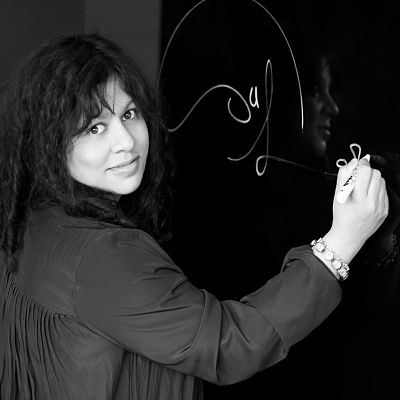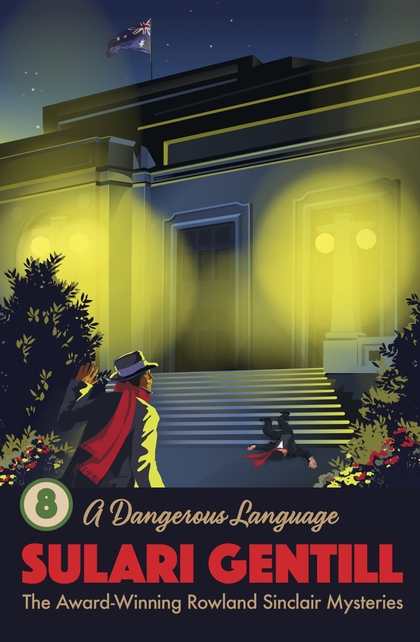
Sulari Gentill set out to study astrophysics, ended up graduating in law, and later abandoned her legal career to write books instead of contracts. Sulari was shortlisted for Best First Book in our region for the Commonwealth Writers' Prize 2011.
She grows French black truffles on her farm in the foothills of the Snowy Mountains of NSW, which she shares with her young family and several animals... the farm, not the truffles.
She has been writing for a few years, but thinking about it most of her life. She’s pretty sure now that writing is what’s she’s supposed to do. This month, Sulari chats to us about her passion for writing and her fascination for Australian history.
Originally you graduated university with a law degree, so what led you to becoming an author?
Sometimes I think everything, including my law degree, led me to becoming a writer.
I started at University studying Astrophysics. As much I quickly realised that I was not meant to be an Astrophysicist, the study of pure mathematics did give me the grounding in logic that is necessary to make a plot, particularly a crime fiction plot, work. I became involved in amateur theatre and on the stage I learned about dialogue and timing. Then the law trained me to write quickly and precisely, to weave a story around given facts. All that was missing was the realisation of what I was really meant to do with that knowledge. Quite stupidly I thought I was supposed to become a lawyer, and so for several years I did just that. But always I felt at though I was living someone else’s life – a perfectly nice life – just not mine.
And then one day, during a conversation with an old friend, I had an idea for a story. I was so excited by the idea that I didn’t stop to worry about whether I could actually write a novel and I just began. It all seemed to fall into place. Once I started writing, it was incomprehensible that I would ever stop.
Is writing something that you’ve always been drawn to or did the love develop later in life?
I’ve been drawn to writing for as long as I can remember. When I was a child and all things seemed possible, I’d think about the books I’d write, the masterpieces I’d paint and the films in which I’d star. As I got older, of course, I became more realistic and less courageous. Writing a novel seemed as outrageous an ambition as winning an Academy Award, so I put those dreams away and pursued a sensible profession. One associated with an income. For a while I was distracted by contracts and deeds. I think there were always stories in my head. At night I would close my eyes and play them out for my own amusement… I just didn’t think that anyone else would be interested. I still dream my books… it’s just that now I write them down.
In truth, though I’ve been writing for only four years, I spent all the decades before gathering material.
Your Rowland Sinclair series is set in Sydney during the 1930s. How did you approach the research that was required for writing the series? Did you discover any interesting or unknown facts about Australian history?
Mostly, I research as I write. My work is story and character driven. I weave my plot and characters into historical events and, whilst I have fallen in love with the eras in which I write, I am always cognisant that I am not producing an historical textbook. What I focus on in my research is the details of the era which are needed to colour what my characters are actually doing, seeing, smelling or thinking. I go looking for those details as and when they come up in my writing...that way, I ensure that I’m not simply inflicting my research on the reader to demonstrate my vast knowledge of plumbing or economics or farming practices in the 1930s.
That being said, I do often just come across an historical figure who is so intriguing that I think “Hmmm… Rowland needs to meet him/her” and somehow find a way for them to wander into the plot. Similarly, some historical events and groups are so interesting that I conspire to have Rowland stumble into them. The glory of writing historical fiction is that I can, through Rowland Sinclair, meet some of the truly amazing, inspiring and often quite mad characters who were out and about in the 1930s.
What inspired you to write a historical crime fiction series?
Initially it was not so much an inspiration as a pragmatic decision. Writing can be quite an isolating passion. As a writer you spend a lot of time living in your own head among people that exist only there. It can be hard on your family, particularly if you have not always been a writer. My husband, Michael, married a perfectly sane, income-producing, corporate-dressing lawyer. Suddenly he found himself financially and otherwise attached to a writer who had “work pyjamas” and would talk to herself. It must have been quite a shock. The poor man also found himself conscripted as the first editor of my work.
I realised early on that I wasn’t ever going to stop writing, and I had no immediate plans to get rid of Michael either, so it occurred to me that in order to ensure his continued cooperation, I would need to bring him into this world in my head… I would need write towards him in a way. Michael is an historian by trade, whose particular expertise is in the extreme right-wing movements of the 1930s in Australia. And so, not coincidentally, the Rowland Sinclair series is set in that era and against that political backdrop.
Of course, once I started delving into the thirties, the era captured my imagination and I was away. But the world of Rowland Sinclair is one which my husband understands and loves and much as I do. He’s happy to edit my manuscripts, to check my historical facts and have conversations about Rowland Sinclair as if he were a real person. Having an expert in the era in bed next to you, is also quite handy. It’s worked out rather well really.
Rowland Sinclair and his cohort are very colourful characters and feel quite genuine. Are they based off any real life inspirations?
Mostly they are a conglomeration of real life inspirations, each having the traits and idiosyncrasies of a number of people I have known. That being said, Wilfred Sinclair quite closely resembles my husband in manner and attitude. I have been known to write Wilfred’s dialogue by asking Michael, “What would you say if…?”, and the just typing in his response. For this reason, I’m often a bit disconcerted if readers express too strong a dislike of Wilfred Sinclair… after all, I married him.
Miles Off Course is the third book in the Rowland Sinclair series. What can readers expect from this latest instalment?
Miles Off Course opens in early 1933. Rowland Sinclair and his companions are ensconced in the superlative luxury of The Hydro Majestic – Medlow Bath, where Edna is receiving treatment and Rowland is struggling with a new nude model.
And then Harry Simpson vanishes.
Croquet and pre-dinner cocktails are abandoned for the High Country of NSW where Rowland hunts for Simpson with a determination that is as mysterious as the disappearance itself. Stockmen, gangsters and a belligerent writer all gather to the fray, as the investigation becomes embroiled with a much darker conspiracy.
This latest instalment once again follows Rowland and his entourage of bohemians into an extraordinary time in Australian history. It brings Rowland to the Snowy Mountains, which is my back yard, and drags him into a rural hotbed of abduction, murder and global subterfuge.
Crime plays an integral part of the plotlines within the series. Is it difficult to come up with a storyline that will be interesting and keep the reader guessing until the end?
I usually start with one event, place or fact (quite often historical) that I find interesting. Then I just start to write. Generally, I have no idea “who did it” until I’m at least halfway through the novel. I figure that if I’m guessing, the reader probably will be too. So far, I haven’t had any trouble coming up with storylines. The period between the wars is so rich in controversy, style and insanity that I’m never short of inspiration.
Not giving anything away, but Rowland and the fiery Edna share an interesting relationship. Where do you see their relationship heading in the future?
Realistically, the story arc of Edna and Rowland’s relationship runs parallel to the greater story arc of the entire series. So much of who they are is defined by what they are to each other. So much of who Edna is, and why Rowland loves her, is about her independence, her ambition and her refusal to relinquish these things.
Of course neither has taken a vow of chastity, and I doubt I’ll be able to resist allowing either of them the odd dalliance. Rowland will continue to be under pressure to settle down and marry an appropriate girl from a good family. He will continue to resist. Edna will continue to resist him… for a while at least.
Without giving anything away, Rowland and Edna will have their moments. Some of these moments will have far-reaching consequences and others will be forgotten by everybody but them.
Along with the familiar faces of Rowland’s faithful friends Milton, Clyde and his brother Wilfred, will we be introduced to any new characters in Miles Off Course? Anyone we should be keeping our eye on?
Harry Simpson. Through him readers may get another insight into the Sinclairs, and into what makes Rowland the man he is. In truth I didn’t initially intend to carry Harry’s story on to future books, but his voice was so strong and warm that I wanted him to stay. Quite unexpectedly, he let me in on a dark and guarded secret, the ramifications of which will play out later in the series.
A Few Right Thinking Men was very well received and was shortlisted for the Commonwealth Writers' Prize for Best First Book. What would it mean to you if Miles Off Course received similar accolades?
Without any pretence of nonchalance, I would be ecstatic. To me, having a book published is like sending your children out into the world. You know they have to make their own way but you worry. When people like them, and are kind to them, it gives you the courage to send out the next child. For each book you have the hope that it will find its own place and friends in the literary world…and, if you’re very lucky, the occasional person that will love it as you do.
So, yes, if Miles Off Course were received as well as A Few Right Thinking Men has been, I would be truly delighted and very grateful.
When can readers expect the next Rowland Sinclair adventure?
Paving the New Road, which takes Rowland and his inappropriate friends to Germany as Hitler is consolidating power, is the next book in the series, and will be released in August 2012.
Comments are not allowed for this entry.